
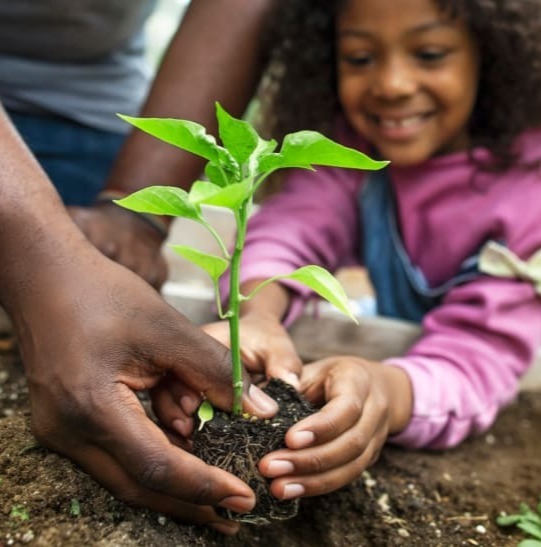
The story behind this campaign
In a small school at the edge of the Sahel, the dry season arrived early last year — and with it, the quiet that hunger always brings. By midday, children who had walked miles to class began to rest their heads on their desks. At home, there simply was not enough food to carry them through the day.
Amina is nine years old, and she loves school — the songs, the stories, the chalk-dust smell of the blackboard. But it is hard to love multiplication tables on an empty stomach. Her teacher, Madame Diallo, watched her fade and felt helpless. A teacher can open a book with a child. She cannot always open a pantry.
Then Dilulu arrived — not with a truck of food that would vanish in a week, but with something built to last a lifetime: a school garden.
First came the seeds: hardy, climate-smart varieties chosen for the region. Then the tools, the compost, and water-saving techniques that respect every precious drop. And something even more valuable — training. Madame Diallo spent a season learning beside a Dilulu educator, and together they turned a dusty plot into a living classroom.
The garden became part of the school day — lessons in English and French about soil and seasons, mathematics measured in plant growth, art sketched from leaves, and the science of why healthy soil feeds healthy children. The garden stopped being a lesson about the environment. It became the classroom itself.
On harvest day, the whole school gathered. Amina carried a basket of tomatoes to the cook, her smile wider than the basket. That afternoon, for the first time in months, every child ate a warm meal at school. That evening, she told her mother: "When I grow up, I want to grow food for our whole village."
That is the true harvest of a school garden — not only vegetables, but dignity, curiosity and hope. Children who believe the future is something they can plant with their own hands.
The harvest we already see across Africa
Dilulu's school-garden programs have reached more than 80 schools and communities across Africa. Where teachers are trained alongside their gardens, we consistently see the same story: harvests that grow to twice the size, gardens that feed around 15 families each, and classrooms where attendance rises because children are not learning on empty stomachs. Principals call their gardens "living classrooms". Mothers call them hope.
Why we need you in 2027
In 2027 we are growing further — taking gardens, teacher training and garden-based learning to dozens more schools in the communities that need them most. But a garden does not plant itself, and a teacher does not train alone. We need seeds, tools, water systems, compost and the educators who turn soil into classrooms.
Our goal is $50,000, and thanks to supporters like you we have already raised more than a third of it. Every gift — whatever its size — becomes soil under a child's fingernails and a warm meal on a school day.
What your gift plants
- $50 — seeds, seedlings and soil for one school's first planting season.
- $150 — a complete starter-garden kit: seeds, hand tools and a first harvest for one school.
- $500 — a full school-garden program for one school: materials, curriculum and educator training.
- $1,200 — a community-garden hub that feeds families and supports several schools with ongoing training.
Dilulu publishes every campaign's progress in real time — you can watch your gift at work, from first seeds to first harvest.
"A child who learns to grow food will never be hungry again — and will teach the next child how to grow it too."
Please give today. Somewhere in Africa, a classroom is waiting for its first green shoot — and a child like Amina is waiting to plant it. That is what we mean when we say Dilulu: growing gardens, growing futures.
Where your money goes
Your contribution directly supports community gardens, school partnerships, and environmental education across Africa. Every donation is tracked, receipted, and put to work where it matters most.